

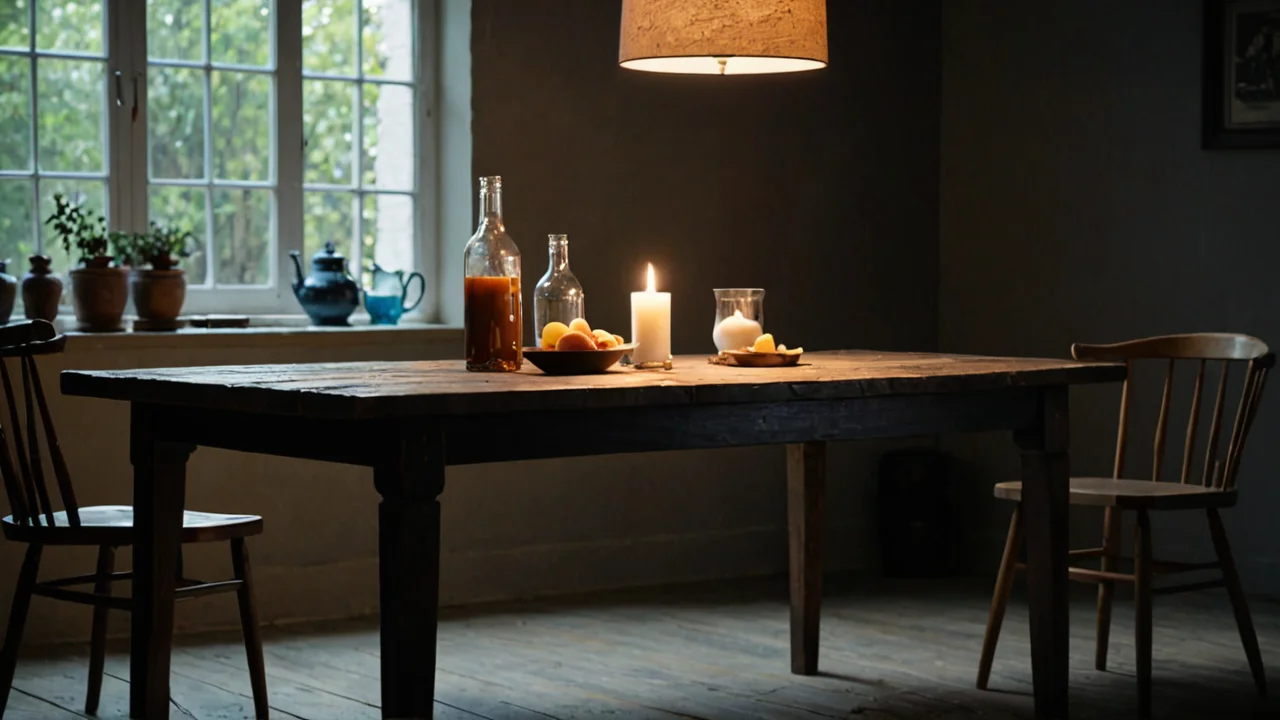
Materials and styles are two separate decisions that get made at the same time, and the order matters more than most people expect. Style determines what a piece looks like; material determines what it will look like in five years, what it weighs, how it fails, and whether it belongs in the room at all. Get the material wrong and no amount of styling saves the piece. Get the style wrong and you have an expensive object you will resent. The useful sequence is constraint first, material second, style last — and the constraints are rarely about taste.
Start with clear width, not with the sofa
Every furniture layout has to leave a path, and in the United States that path has a number attached to it. Under the 2024 edition of NFPA 101, any required means of egress path needs a clear width of 28 in (710 mm) minimum. Under the 2015 Life Safety Code edition as adopted by various jurisdictions, a furniture-formed exit access path serving up to six people in a room needs the same 28 in (710 mm) minimum clear width, while a standard means of egress door or corridor serving more than six people needs 36 in (915 mm) minimum width clear of obstructions.
Those two figures do different jobs and people conflate them constantly. The 28 in number is the one that governs how you arrange chairs around a dining table, how far a console sits from a wall, and whether a reading nook has quietly become a dead end. The 36 in number is about the door and the corridor — the parts of the building you did not design and mostly cannot change. A room can be perfectly legal on paper and still feel wrong because the furniture path is at the bare minimum with no room to turn.
What goes wrong in practice is not a code violation. It is a 28 in gap that technically passes and practically fails, because a chair pushed back, a coat dropped, or a floor lamp with a wide base eats into it. Clear width is measured free of obstructions, and obstructions in a home are mostly temporary and mostly invisible to whoever drew the plan. Treat the minimum as a floor, not a target. If a layout only works at exactly 28 in, it does not work.
The trade-off is honest: generous circulation costs floor area, and floor area is the most expensive thing in the room. A deep sofa pulled 3 ft off the wall to open a path behind it buys you movement and costs you a seating row. In small rooms the right answer is usually fewer, lighter pieces rather than tighter gaps — a pair of small pull-up chairs beats one oversized armchair that pins the circulation.
Wood is a family of materials, not one material
Solid wood, veneer over engineered core, and composite board are three different products with three different failure modes, and the finish on top does not change which one you bought. Solid wood moves with humidity, which is why a wide glued-up tabletop needs room to expand at the edges and why a tight mitred frame around a solid panel will eventually crack at the joint. Veneer over a stable core is more dimensionally calm and lets you use cuts of timber that would be impossible as solid stock — book-matched, quartered, wide. Composite board is flat, cheap, and strong in the plane but weak at fasteners that get loaded repeatedly; the screw holes in a particleboard hinge plate are the first thing to strip.
Where you notice the difference is at the joints and at the edges. Look at how a shelf meets a side: a dado or a housing joint resists load, biscuits and dowels align but do not carry much, and cam locks are fine until they are not. Look at the edge of a veneered top — a thick applied edge band survives knocks, a thin one lifts and then peels. None of this is visible in a photograph, which is why buying furniture from images alone is a gamble on the material rather than the style.
Shelf load is the one place where a number exists and it is worth knowing. IS 7070:1988 specifies that a wooden shelf must carry a uniformly distributed load of 40 kg per metre of shelf length per 100 mm shelf depth for 24 hours without failure — a 1 m span, 300 mm deep shelf must hold 120 kg. A uniformly distributed load is spread evenly across the full length, which is exactly how a shelf is not loaded in real life. Books cluster. A run of hardbacks in the middle of a span is a point load, and point loads are what break shelves, not the even weight the test describes. Keep long spans supported in the middle or keep heavy volumes at the ends.
The cost of going up the material ladder is mostly invisible in the finished object. You are paying for joint quality, for thickness, for how the piece was dried and how long it rested before machining. That money buys you a piece that does not creak in winter and does not develop a hairline crack along the glue line in the first dry season.
Finish is a chemistry decision with a legal ceiling
Finishes divide into evaporative (lacquer, shellac, most water-based acrylics and polyurethanes) and reactive (oil-based varnish, two-part catalyzed coatings, hardwax oil that cures by crosslinking). Evaporative finishes dry fast, are easy to repair with a fresh coat that melts into the old one, and are softer. Reactive finishes cure hard, resist solvents and heat, and are much harder to spot-repair — a burn or a ring means sanding back to bare wood in that area.
Volatile organic compounds are regulated, and the ceilings are real. Under Section 5-253-16 of the Connecticut Department of Energy and Environmental Protection regulations on wood furniture manufacturing, which incorporate EPA CTG guidance, topcoats used at large stationary sources are limited to 1.8 lb VOC per lb solids as applied, sealers to 1.9 lb VOC per lb solids, and strippable spray booth coatings to 0.8 lb VOC per lb solids. Those are industrial limits, not residential ones, and they tell you something useful: the high-solvent lacquers that gave mid-century furniture its thin, glassy look are increasingly hard to buy and hard to spray legally. What replaced them is waterborne and higher-solids chemistry that behaves differently — it raises grain, it needs better sanding between coats, and it does not burn in the way nitrocellulose does.
For a buyer, the practical read is this: a factory-applied conversion varnish or catalyzed lacquer is the most durable finish you will get on a wooden piece, and it is also the least repairable. A hardwax oil is the most repairable and the least protective against standing water. Oil finishes darken and need re-oiling; water-based finishes stay closer to the raw wood color and stay clearer as they age. The trade-off is a straight line — durability against repairability — and where you sit on it depends on whether the piece will be used hard or admired.
What goes wrong: a water-based finish applied too thick over a poorly sanded surface will show every drum-sander mark under raking light, and you will only see it in late afternoon sun against a window. A reactive finish applied over an incompletely cured oil will wrinkle within days. Neither is a style problem. Both are finish chemistry problems that arrive looking like a defect in the wood.
Upholstery: the filling decides the lifespan, the fabric decides the look
Two sofas in the same fabric and the same silhouette can differ by a decade of useful life, and the difference is the frame and the foam. A hardwood frame with glued and corner-blocked joints outlasts a softwood frame stapled together, and you cannot see either from the showroom floor. Foam density matters more than foam thickness: a high-density core wrapped in a softer layer holds its shape, while a thick low-density block feels wonderful for a year and then develops a permanent valley where you sit. Eight-way hand-tied springs are the traditional benchmark; sinuous wire and elastic webbing are cheaper, lighter, and entirely adequate for occasional seating, and they will not survive the same daily use.
Fabric choice is where style and material collide most visibly. A tight plain weave in a high-abrasion fiber is the workhorse; a loose slubby weave looks superb and snags on everything, including a zipper. Velvet and chenille show every handprint and every crush mark, which some people love and some people cannot live with. Leather is the most forgiving surface for spills and the least forgiving for scratches. None of these are good or bad in the abstract — they are good or bad against a specific household with specific habits.
The honest trade-off: a well-built sofa you reupholster once is usually cheaper over its life than two cheap sofas, but only if the frame and springs are sound. Reupholstering a frame with tired springs is throwing money at a problem the new fabric will not fix. Ask what the frame is made of and how the joints are made before you ask about the fabric, because the fabric is the only part you can change later.
Style is a set of constraints, not a mood board
A style is a coherent set of rules about proportion, line, and how much ornament a piece carries — and the rules are what make a room read as one thing rather than a collection. Mid-century modern is low, horizontal, and tapered, with legs that lift the mass off the floor and let light underneath. Traditional is vertical, symmetrical, and skirted, with mass carried to the floor and detail concentrated at the top of the piece. Industrial is exposed structure as decoration. Japandi and Scandinavian-adjacent styles are quieter: pale wood, restrained color, and a strong preference for natural over coated surfaces.
Mixing works when the pieces agree on two of three variables — scale, material, and period — and breaks when they agree on none. A heavy carved traditional sideboard next to a slim tapered-leg sofa does not fail because styles cannot mix; it fails because the visual weight is wildly mismatched and the eye keeps returning to the imbalance. The fix is usually scale, not period: pull the heavy piece out, or put something with comparable mass next to it.
Style also has a cost structure that people underestimate. Ornament is labor — carving, inlay, applied molding, hand-polishing — so a richly detailed piece at a low price is almost always a molded or printed imitation, and it will look flat in raking light next to the real thing. Minimal styles have the opposite problem: with no ornament to hide behind, every joint and every edge is on display, so the piece has to be made well or it is immediately obvious. A simple object is not a cheap object to make correctly.
The wrong choice is choosing a style for a room you do not have. A low-slung, deep-seated modern sofa is magnificent in a large room and oppressive in a small one, where it eats the floor and blocks the view across the space. Conversely a tall traditional armchair can make a low-ceilinged room feel cramped in a way the measurements do not predict.
Matching material to room, and knowing when to stop
Humidity and light decide more than taste does. Solid wood wants stable indoor humidity; a piece that lives near a radiator or a south-facing window will move, crack, or fade regardless of how well it was made. Leather dries and cracks in dry heat and fades in direct sun. Water-based finishes stay clearer than oil over time, and oil-finished pieces need periodic re-oiling to stay even. If a room is bright and dry, a veneered piece with a stable core and a factory finish will hold up better than a solid slab with an oil finish, even though the solid slab is the more expensive object.
Weight and access are the constraints nobody plans for. A solid stone or thick engineered top on a large sideboard can be immovable once assembled, which matters if the room will ever be repainted. Flat-pack construction exists because it solves a real problem — getting a large object up a narrow stair — and the material compromise it makes is usually at the joints. If a piece will be disassembled and moved more than once, that compromise is worth accepting; if it will sit in one place for twenty years, it is not.
Where to stop: pick the material for the pieces that take the most load and the most use — the sofa, the dining table, the shelving — and let style lead on the pieces that are mostly visual. Shelving deserves the most attention because it is the piece most likely to be overloaded, and the piece where a failure is least forgiving. Dining tables take the second-most, because they take heat, water, and elbows. Case goods and occasional pieces can be chosen almost entirely on looks, because they are rarely stressed.
The final check is the one that catches most mistakes: walk the room and follow the path from the far corner to the door. If anything forces you to turn sideways, the layout has failed no matter how good the materials are. That is the point where style stops being the question. A room that works at the level of clear width, material honesty, and load will tolerate almost any style you put in it; a room that fails those three will never look right, however carefully it was styled.